

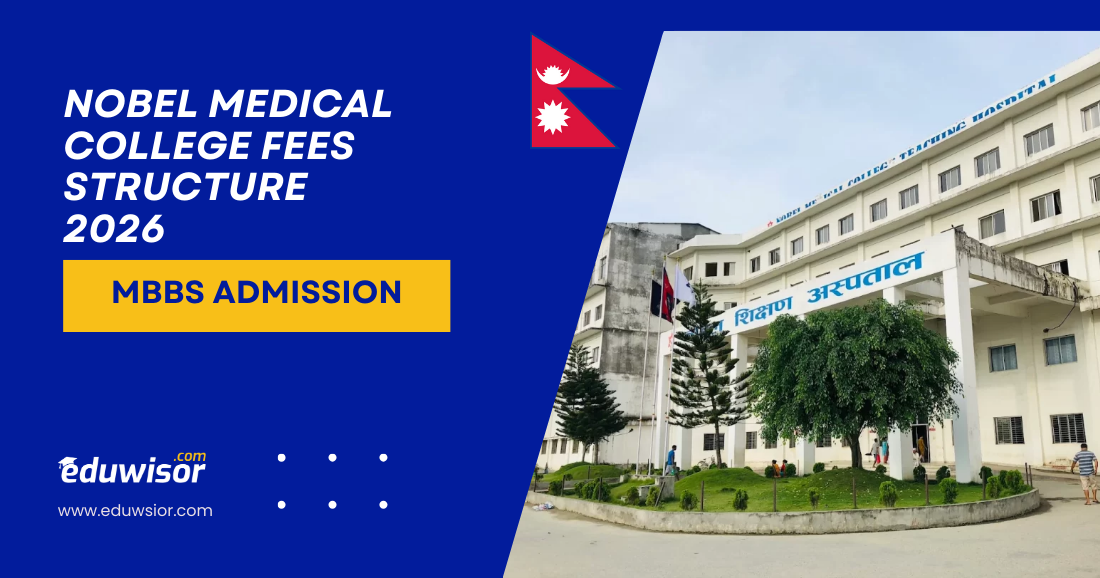
Embarking on the journey to become a doctor is a dream fueled by passion, dedication, and a significant financial investment. Choosing the right medical college is a decision that shapes not only your academic and professional future but also your family’s financial planning. In the landscape of medical education in Nepal, Nobel Medical College and Teaching Hospital (NMCTH) in Biratnagar stands as a prominent institution, attracting a large number of aspiring medical students from Nepal, India, and beyond.
A critical component of this decision-making process is a crystal-clear understanding of the Nobel Medical College fees structure. This comprehensive guide is designed to be your one-stop resource, moving beyond a simple fee list to provide a holistic analysis of costs, value, financial planning, and the return on investment of an MBBS degree from Nobel Medical College. We will dissect every component, from the first admission fee to the final year charges, including often-overlooked expenses, to empower you with the knowledge to plan effectively.
Understanding the Institutional Context: Why Nobel Medical College?
Before delving into numbers, it’s vital to understand what you are investing in. Established with a vision to provide exemplary medical education and healthcare, Nobel Medical College is affiliated with Kathmandu University and recognized by the Nepal Medical Council (NMC), the Sri Lankan Medical Council (SLMC), and listed in the World Directory of Medical Schools (WDOMS). This recognition makes its MBBS degree globally valid, a key factor for students aiming for international practice or higher studies.
The college boasts a 750-bedded teaching hospital, providing students with extensive clinical exposure from the early years. The infrastructure includes modern laboratories, a well-stocked library, digital classrooms, and advanced simulation centers. The faculty comprises experienced and qualified medical professionals dedicated to both teaching and research. This robust academic and clinical ecosystem forms the backdrop against which the Nobel Medical College MBBS fees should be evaluated.
Detailed Breakdown of the Nobel Medical College Fees Structure for 2025 Intake
The fee structure for Nobel Medical College is typically revised annually. The figures provided here are based on the latest available data for the 2026/2025 academic session. It is always recommended to verify the exact amounts directly from the college’s admission office before proceeding.
The total cost is generally divided into several installments over the 5.5-year MBBS program (4.5 years of academic study + 1 year of compulsory internship). The fees are quoted in US Dollars or Nepali Rupees for international and Nepali students, respectively, with separate quotas often having different fee scales.
For International Students (Including Indian Students):
The total package cost for the complete MBBS program is typically a lump sum. However, it is paid in installments.
- Total Program Fee (Approx.): USD 70,000 – USD 85,000 (This is an all-inclusive package covering core costs).
- Payment Schedule:
- First Installment (On Admission): USD 25,000 – USD 30,000. This includes admission fee, first year’s tuition, and a security deposit.
- Second Installment (Beginning of 2nd Year): USD 15,000 – USD 20,000.
- Third Installment (Beginning of 3rd Year): USD 15,000 – USD 20,000.
- Fourth Installment (Beginning of 4th Year): USD 10,000 – USD 15,000.
For Nepali Students (Under Different Quotas):
The fee structure is more itemized for Nepali citizens.
- Admission Fee (One-time, Non-refundable): NPR 500,000 – NPR 800,000 (approx.).
- Tuition Fee (Per Year): NPR 1,200,000 – NPR 1,800,000 per annum. This is the core academic charge.
- Student Welfare Fund / Development Fee (One-time): NPR 100,000 – NPR 200,000.
- Security Deposit (Refundable): NPR 200,000 – NPR 300,000. This is returned upon completion of the program, pending any dues.
- Hostel & Mess Charges (Per Year):
- Hostel Accommodation: NPR 150,000 – NPR 250,000 per year (depending on room type: single, double, or triple sharing).
- Mess/Food Charges: NPR 120,000 – NPR 180,000 per year (approx. NPR 10,000 – 15,000 per month for three meals a day).
- Other Annual Charges:
- Examination Fee: NPR 15,000 – NPR 30,000 per year (for internal and university exams).
- Laboratory Fee: NPR 50,000 – NPR 80,000 per year.
- Library Fee: NPR 10,000 – NPR 20,000 per year.
- Medical Insurance: NPR 10,000 – NPR 15,000 per year.
The “Hidden” or Often Unplanned Costs: Budgeting for the Complete Picture
A realistic budget must account for expenses beyond the official fee slip. Ignoring these can lead to financial strain.
- Living Expenses in Biratnagar: While more affordable than Kathmandu, personal expenses for transportation, stationery, internet, and leisure can range from NPR 5,000 to NPR 10,000 per month.
- Books and Study Materials: Despite a good library, students often purchase personal copies of standard medical textbooks (e.g., Gray’s Anatomy, Guyton’s Physiology, Harrison’s Medicine). This can be a one-time investment of NPR 50,000 – NPR 100,000 over the course.
- Medical Equipment: Stethoscopes, lab coats, dissection kits, and other instruments can cost NPR 20,000 – NPR 40,000 initially.
- Travel Costs: For international and out-of-state students, annual travel to and from home during vacations is a significant expense.
- Miscellaneous University Charges: Charges for re-examinations, supplementary exams, transcript applications, and convocation ceremony fees can add up.
Estimated Total Projected Cost for a Nepali Student (Full 5.5 Years):
Considering all the above factors, the total cost of studying MBBS at Nobel Medical College for a Nepali student can realistically range between NPR 1.2 Crore to NPR 1.8 Crore (approximately USD 90,000 – USD 135,000), depending on the quota, lifestyle, and year of admission.
Financial Support: Navigating Scholarships and Education Loans
Understanding that this is a substantial investment, Nobel Medical College and other entities offer financial aid options.
A. Nobel Medical College Scholarship Programs:
The college itself offers merit-based and need-based scholarships, often covering a percentage of the tuition fee.
- Merit Scholarships: Awarded to students with exceptionally high scores in the entrance exam (like Kathmandu University’s MBBS Entrance or based on NEET UG scores for Indian students). These can cover 25% to 50% of tuition fees.
- Need-Based Scholarships: For economically disadvantaged students with a strong academic record. Documentation of family income is required.
- Scholarships for Exceptional Talent: In sports, arts, or other extracurricular domains.
- District/Provincial Quotas: Some scholarships are reserved for students from specific underprivileged regions of Nepal.
How to Apply: Information is provided during the admission cycle. Candidates must submit separate scholarship applications with supporting documents. The selection is competitive.
B. Government and External Scholarships:
- Government of Nepal Scholarships: Provided through the Ministry of Education for deserving students.
- External Donor Scholarships: Various NGOs and trusts in Nepal and India offer scholarships for medical studies.
C. Education Loans:
Most major banks in Nepal and India offer dedicated education loans for medical studies.
- Coverage: They typically cover up to 80-90% of the total tuition and institutional fees. Living expenses may also be partially covered.
- Collateral: Loans above a certain amount require collateral (property, fixed deposits).
- Moratorium Period: Repayment usually begins 6-12 months after course completion, providing a grace period.
- Interest Rates: Vary but are generally competitive for education loans. It’s crucial to compare terms from multiple banks like Nabil Bank, NIC Asia, Everest Bank in Nepal, or SBI, Canara Bank, and HDFC Credila in India.
Evaluating the Return on Investment (ROI): Is Nobel Medical College Worth the Fee?
The Nobel Medical College fees structure is undoubtedly at the higher end in Nepal. The critical question is ROI.
Tangible Returns:
- Globally Recognized Degree: Affiliation with Kathmandu University and WDMS listing opens doors for USMLE, PLAB, or other licensing exams for practice in the USA, UK, Australia, etc.
- Clinical Exposure: The attached 750-bed hospital with high patient inflow ensures hands-on clinical training, making graduates practice-ready.
- Post-Graduate Opportunities: Strong academic foundation facilitates success in post-graduate entrance exams (MD/MS in Nepal, NEET-PG in India, or international residencies).
- Internship Stipend: During the compulsory one-year internship, students receive a monthly stipend (typically NPR 15,000 – NPR 25,000), which is a small but helpful return.
Intangible Returns:
- Alumni Network: Joining a growing community of Nobel Medical College alumni practicing globally.
- Skill Development: Beyond medicine, students develop critical thinking, communication, and resilience in a dynamic hospital environment.
- Career Platform: The college’s reputation serves as a strong foundation for future career placements.
Comparative Analysis: Nobel Medical College Fees vs. Other Private Colleges in Nepal
How does Nobel stack up against its peers?
- Compared to Kathmandu-based colleges: Nobel’s fees are often slightly lower than premier colleges in Kathmandu like Kathmandu University School of Medical Sciences (KUSMS) or Manipal College of Medical Sciences (MCOMS), Pokhara, but the difference is not massive. The cost of living in Biratnagar, however, is significantly lower than in Kathmandu or Pokhara, leading to overall savings.
- Compared to other regional colleges: Its fees are competitive with other reputable teaching hospitals in the region. The deciding factor often becomes the infrastructure and hospital bed capacity, where Nobel has a distinct advantage due to its large teaching hospital.
Step-by-Step Admission Process and Financial Planning Timeline
- Eligibility Check (Jan-Mar): Ensure you meet the academic criteria (10+2 with Physics, Chemistry, Biology) and minimum marks (usually 50% aggregate for Nepali students). For Indian students, a valid NEET UG score is mandatory.
- Entrance Exam (Apr-Jun): Appear for the Kathmandu University (KU) MBBS Entrance Exam or apply through the NEET UG channel for the international quota.
- Result & Counseling (Jun-Jul): Upon securing a rank, participate in the centralized counseling process.
- Seat Allotment & Fee Deposit (Jul-Aug): Once allotted Nobel Medical College, you will receive an offer letter with the exact fee payment schedule. The first, and largest, installment is due within a short period to confirm the seat.
- Documentation & Enrollment (Aug-Sep): Submit all academic certificates, character certificates, and migration certificates. Complete the enrollment formalities.
- Financial Planning (Ongoing): If seeking a loan, start the process immediately after seat allotment. Apply for scholarships concurrently.
Crucial FAQs on Fees and Admissions
Q1. Does the total fee for international students include hostel and mess charges?
Usually, the lump-sum package for international students includes tuition and basic hostel accommodation. However, mess/food charges are often separate. Clarify this explicitly with the admission office.
Q2. What is the refund policy if I withdraw my admission?
This is critical. Typically, if a student withdraws before the course starts, a significant portion (but not all) of the paid fees may be refunded, excluding the admission fee. After classes commence, the refund percentage drops drastically, often to 0% after a month. Always get the refund policy in writing.
Q3. Are there any installment options beyond the yearly schedule?
The standard schedule is annual/semester-wise. Some colleges may have tie-ups with financial institutions for EMI options on the fees, but this is not common. Personal education loans are the primary tool for managing cash flow.
Q4. How much should I budget for the first year in total?
For the first year, budget for: First Installment (Tuition + Admission) + Hostel & Mess for one year + Security Deposit + Cost of books/equipment + Living expenses. This can be 40-50% of the total 5.5-year cost.
Q5. Is the security deposit completely refundable?
Yes, provided the student has no outstanding dues for library fines, hostel damages, or other college charges. The refund is processed after the completion of the final internship.
Conclusion: Making an Informed Decision
Deciphering the Nobel Medical College fees structure is more than just adding numbers; it’s about understanding the value proposition of a premium medical education. While the financial commitment is substantial, the investment is in a career that is not just a job but a lifelong vocation with immense societal respect and personal fulfillment.
Prospective students and parents are advised to:
- Contact the college’s accounts and admission department directly for the most current, official fee structure.
- Visit the campus if possible to assess the infrastructure, hostel facilities, and talk to current students about their experience of costs and education quality.
- Plan finances meticulously at least a year in advance, exploring all scholarship and loan options.
- View the fee as an investment and evaluate it against the college’s academic rigor, hospital facilities, faculty, and final outcomes (post-graduate placements, licensing exam success rates).
Choosing a medical college is a pivotal step. By having a 360-degree view of the costs, benefits, and financial pathways, you can approach your dream of becoming a doctor at Nobel Medical College with clarity, confidence, and solid financial preparedness. Your journey in healing begins with informed planning.
Eduwisor always guides students toward the right path with an unbiased approach. You can follow us on Youtube, Facebook, Instagram, Twitter, and Linkedin. Stay tuned for regular updates.
Interested in applying? Contact authorized Eduwisor consultant for a smooth admission process!
Act NOW—limited seats for 2026 intake! Call/WhatsApp: 9326395883/ 9076036383
