
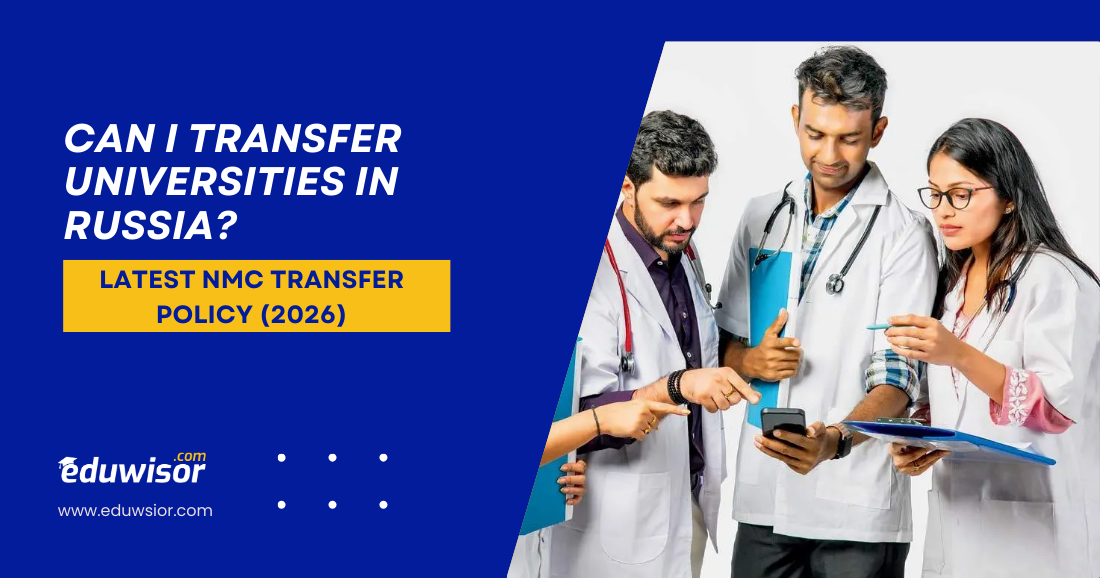
Under the latest NMC Transfer Policy MBBS Abroad, Indian students cannot transfer universities mid-course unless under extremely rare humanitarian or geopolitical situations. The National Medical Commission (NMC) requires foreign medical graduates to complete their entire MBBS program from the same recognized university to remain eligible for licensing in India.
Becoming a doctor is one of the biggest dreams for Indian students. But getting an MBBS seat in India? That’s tough. Every year, over 20 lakh NEET aspirants compete for roughly 1 lakh MBBS seats. Naturally, thousands look abroad — especially to Russia, Uzbekistan, Kazakhstan, and other countries offering affordable medical education.
But here’s a question we hear almost every week at Eduwisor’s Mumbai office:
“Sir, if I don’t like my university in Russia… can I transfer to another one?”
It sounds reasonable. In many degree programs worldwide, transfers happen all the time.
But MBBS abroad is different.
And the National Medical Commission (NMC) has made the rules extremely clear.
Let’s unpack the latest NMC transfer policy for MBBS abroad, what it means for Indian students studying in Russia, and why choosing the right university from day one is absolutely critical.
Understanding the NMC Foreign Medical Graduate Regulations (FMGR 2021)
The Foreign Medical Graduate Regulations (FMGR) 2021, issued by NMC, require Indian students studying MBBS abroad to complete a 54-month medical course and 12-month internship at the same university and country. Any mid-course transfer typically violates eligibility requirements for licensing exams like FMGE or NExT.
The FMGR 2021 rules changed everything.
Before these regulations, many students treated MBBS abroad like a flexible academic journey.
Start somewhere. Transfer later if needed.
But NMC saw problems:
- Students moving between universities with different curricula
- Internships not matching Indian clinical standards
- Degrees from institutions with unclear accreditation
So NMC introduced stricter rules.
Core Requirements Under FMGL 2021
| Requirement | NMC Rule |
| Course duration | Minimum 54 months |
| Internship | 12 months mandatory |
| Same university | Entire course must be completed at one institution |
| Medium of instruction | English |
| Licensing eligibility | Must qualify FMGE or NExT |
The same university rule is where transfers become problematic
Why NMC Strictly Discourages University Transfers
NMC discourages MBBS transfers because moving between universities disrupts curriculum continuity, internship training, and clinical exposure. Since each medical university follows a different academic structure, transfers can make students ineligible for FMGE/NExT licensing in India.
Let’s look at what actually happens.
A student studies 2 years in one Russian university, then transfers to another.
Sounds simple.
But the reality?
Medical programs differ widely.
Differences Between Universities
- Curriculum sequencing
- Clinical training hours
- Internship format
- Hospital affiliations
- Language support programs
Even within Russia, universities don’t follow identical structures.
For example:
| University | Early Clinical Exposure | Internship Structure |
| Kazan Federal University | Starts Year 2 | Integrated hospital training |
| Bashkir State Medical University | Starts Year 3 | Structured internship rotations |
| Crimea Federal University | Starts Year 3 | Separate internship year |
If a student transfers mid-course, the curriculum gaps can be huge.
And NMC doesn’t evaluate those gaps case-by-case.
Instead, they apply a strict eligibility filter.
What the NMC Says About Transfers (Official Interpretation)
The NMC expects students to complete the entire medical program in one foreign institution. Transfers are only considered valid in extraordinary cases such as war, diplomatic breakdowns, or institutional closure, and even then approval is not guaranteed.
This became a major issue during the Russia-Ukraine war in 2022.
Thousands of Indian students studying in Ukraine were displaced.
Many hoped to transfer to universities in Russia or Central Asia.
But the NMC response was cautious.
Why?
Because the regulatory system prioritizes uniform training standards.
Students who transferred without proper regulatory approval risked losing licensure eligibility in India.
Real Example From Our Eduwisor Counseling Desk
And this is something we saw personally.
A student visited our Eduwisor Mumbai office in Andheri last year.
He had completed two years in a small Eastern European medical university.
The campus was underdeveloped. Clinical exposure was minimal.
So he transferred to another university in Kazakhstan.
But when he came to us, he asked:
“Will I still be eligible for FMGE?”
We had to tell him the truth.
The transfer created documentation complications with NMC verification.
Now he must go through additional scrutiny.
And the outcome? Not guaranteed.
That’s why we emphasize choosing the right university from the start.
MBBS in Russia: Can Internal Transfers Happen?
Internal transfers within Russia may happen at the university level, but they do not guarantee eligibility under NMC rules. Even if Russian universities allow transfers, Indian students must ensure the move does not violate the FMGR requirement of completing the course at a single institution.
Some universities technically allow transfers.
But here’s the catch.
University approval does not equal NMC approval.
Russian academic rules and Indian licensing rules are two different systems.
This is where many consultancies mislead students.
They say:
“Transfer is possible.”
But they rarely explain the NMC consequences.
At Eduwisor, we refuse to hide these realities.
Common Reasons Students Want to Transfer Universities
Let’s be honest.
Students rarely consider transfers without reason.
Here are the most common triggers we hear.
1. Poor Infrastructure
Some low-tier universities lack modern laboratories or simulation centers.
2. Language Barriers
Although programs are labeled “English medium,” local languages often dominate clinical training.
3. Limited Hospital Exposure
Certain universities provide fewer real patient interactions.
4. Misleading Consultancies
Sadly, some agents push students into unknown universities simply because they pay higher commissions.
That’s why our Zero-Hidden-Fee policy at Eduwisor exists.
Transparency protects students.
Myth vs Fact: MBBS Transfers Abroad
| Myth | Fact |
| You can easily transfer universities abroad | NMC regulations make transfers extremely risky |
| Russian universities freely allow transfers | Even if they do, NMC may reject eligibility |
| Transfer after first year is safe | NMC requires completion at the same university |
| Agents can arrange NMC approval | Only NMC decides licensing eligibility |
Why Choosing the Right University From Day One Matters
Because the NMC transfer policy is strict, selecting the right university before admission is critical. Students should verify accreditation, clinical exposure, English instruction, and FMGE/NExT preparation support before enrolling.
At Eduwisor, we evaluate universities across five critical parameters.
1. NMC Compliance
Does the program meet all FMGR requirements?
2. Clinical Training Quality
Real hospital exposure matters more than campus buildings.
3. English Medium Integrity
Not just in theory — in actual classroom practice.
4. FMGE/NExT Preparation
Integrated coaching improves pass rates.
5. University Reputation
Global ranking and recognition influence career opportunities.
Russia vs Other Countries for Stable MBBS Programs
Here’s a quick comparison many students ask about.
| Country | Avg Total Cost | NMC Compliance | English Medium | Indian Student Support |
| Russia | ₹25–40 Lakhs | High | Yes | Strong |
| Uzbekistan | ₹20–28 Lakhs | High | Yes | Growing |
| Kazakhstan | ₹22–30 Lakhs | High | Yes | Good |
| Philippines | ₹35–50 Lakhs | Medium | Yes | Moderate |
Russia remains a top destination largely because of:
- Long-standing medical universities
- Large Indian student communities
- Strong clinical hospitals
And yes — some universities even serve Indian food daily.
One student recently told us:
“The Indian mess at Kazan Federal serves fresh Aloo Parathas every Tuesday morning.”
Small details. But when you’re living abroad for six years, they matter.
Eduwisor’s Approach: Preventing Transfer Problems
We designed our counseling process to eliminate transfer risks entirely.
Step 1: University Screening
We shortlist only institutions meeting strict NMC criteria.
Step 2: Direct University Tie-Ups
No middle agents. Students pay universities directly.
Step 3: Transparent Fee Structure
Our Zero-Hidden-Fee guarantee protects families from surprises.
Step 4: Integrated FMGE/NExT Coaching
Preparation begins during the MBBS course.
Step 5: Post-Admission Support
From visa guidance to accommodation.
Our mission is simple:
Make sure students never need a transfer.
What Happens If You Transfer Without NMC Approval?
Students who transfer universities without clear compliance with NMC regulations risk becoming ineligible for medical licensing exams in India, including FMGE and the upcoming NExT exam.
Consequences can be severe.
Possible Risks
- Degree not recognized
- Ineligibility for FMGE/NExT
- Need to restart MBBS
- Loss of years of study
- Financial losses
And unfortunately, we’ve seen these situations firsthand.
NExT Exam and Future Regulations
India is transitioning toward the National Exit Test (NExT).
This exam will replace FMGE.
But the eligibility principles remain the same:
- Recognized university
- Complete course duration
- Verified internship
Transfers will continue to be scrutinized.
Frequently Asked Questions (FAQ) – NMC Transfer Policy MBBS Abroad
Can I transfer from one Russian university to another?
Under the NMC transfer policy for MBBS abroad, transfers are generally not allowed because the student must complete the entire course at the same institution to remain eligible for licensing in India.
Are transfers allowed during emergencies?
Transfers may be considered during extraordinary circumstances such as war or university closure, but approval depends on NMC evaluation and is not guaranteed.
Can I transfer after first year of MBBS abroad?
Even transfers after the first year can create eligibility issues because NMC requires completion of the entire medical program at one university.
Do Russian universities allow transfers?
Some universities may allow academic transfers internally, but that does not ensure compliance with NMC licensing requirements.
What happens if I transfer anyway?
You risk becoming ineligible for FMGE or NExT, which means you cannot practice medicine in India.
Is MBBS in Russia still safe for Indian students?
Yes, if students choose NMC-compliant universities and complete the full program without transfers.
How can I choose the right university?
Work with transparent consultancies like Eduwisor, which have direct university partnerships and verified admission processes.
Does Eduwisor help with FMGE or NExT preparation?
Yes. Our students receive integrated FMGE/NExT coaching during MBBS, significantly improving exam readiness.
Final Thoughts: NMC Transfer Policy MBBS Abroad
Studying MBBS abroad can be one of the best decisions for Indian students.
But only if it’s done correctly.
The NMC transfer policy for MBBS abroad makes one thing clear:
Transfers are not part of the plan.
The safest path is simple.
Choose the right university from the beginning.
And work with advisors who prioritize transparency over commissions.
That’s exactly what we’ve built at Eduwisor.
Free Counseling with Eduwisor
Still confused about MBBS in Russia or abroad?
We’d be happy to help.
Book a free counseling session with our expert advisors:
📍 Visit Eduwisor’s Mumbai HQ
💻 Or connect with us via Zoom counseling
🏢 Or meet our team at a local office near you
During the session we’ll help you:
- Identify NMC-approved universities
- Understand complete MBBS costs
- Plan your FMGE/NExT preparation strategy
- Avoid risky universities that force transfers later
Because your dream of becoming a doctor deserves clarity, honesty, and the right guidance.
Eduwisor always guides students toward the right path with an unbiased approach. You can follow us on Youtube, Facebook, Instagram, Twitter, and Linkedin. Stay tuned for regular updates.
Interested in applying? Contact authorized Eduwisor consultant for a smooth admission process!
Act NOW—limited seats for 2026 intake! Call/WhatsApp: 9326395883/ 9076036383