

The dream of wearing the white coat and serving humanity is a powerful one. For thousands of aspiring Indian doctors, this dream encounters its first major hurdle: the National Eligibility cum Entrance Test (NEET). With intense competition and limited seats in India, many bright minds seek alternative pathways. One of the most time-tested, reliable, and surprisingly accessible routes is pursuing an MBBS in Russia without NEET and with affordable fees.
For over three decades, Russia has been a steadfast destination for Indian medical aspirants. The combination of world-class education, internationally recognized degrees, and a cost-effective structure makes it a beacon of hope. But the landscape is filled with questions, myths, and a need for clear guidance. Is it really possible to skip NEET? How affordable is “affordable”? What about the quality? And most importantly, what happens after the degree?
This definitive 5500+ word guide is crafted to be your compass. We will navigate through every critical aspect—from the fundamental “why Russia?” to the intricate details of daily life and future careers. Whether you are a student or a concerned parent, consider this your one-stop repository for authentic information on building a medical career through Russian medical universities.
Chapter 1: Why MBBS in Russia? The Compelling Advantages for Indian Medical Students
Russia isn’t just an alternative; for many, it’s a preferred choice. Here’s a deep dive into the advantages that make it stand out.
1. No NEET UG Mandatory for Admission (The Primary Attraction):
This is the most significant advantage. Russian universities select students based on their Class 12 marks (primarily in Physics, Chemistry, and Biology). They do not require a NEET score for issuing an admission letter or granting a student visa. However, a crucial clarification: To practice medicine in India after your degree, you MUST qualify the NEET exam. The exemption is only for admission to the foreign university. The National Medical Commission (NMC) mandates that any Indian citizen seeking to study medicine abroad must have qualified NEET. So, you need to appear and pass NEET to get an Eligibility Certificate from NMC and later to appear for the FMGE/NExT. But the pressure shifts from “cracking NEET for a seat” to “qualifying NEET” as a basic requirement.
2. Globally Recognized Degrees & MCI/NMC Approval:
Top Russian medical universities are listed in the World Directory of Medical Schools (WDOMS) and approved by the National Medical Commission (NMC), formerly MCI. Degrees from these institutions make you eligible to sit for the Foreign Medical Graduates Examination (FMGE) in India or pursue postgraduate studies or practice in many other countries, subject to their respective licensing exams (USMLE, PLAB, etc.).
3. World-Class Infrastructure & Historic Pedigree:
Russian medical education has a rich history of excellence. Universities like Moscow State Medical University (Sechenov) and St. Petersburg State Pediatric Medical Academy are centuries-old institutions with formidable reputations. They boast state-of-the-art laboratories, advanced research facilities, and affiliations with massive multi-specialty hospitals, providing students with exposure to diverse medical cases.
4. Affordable Tuition Fees & Low Cost of Living:
Compared to private Indian medical colleges where donations and fees can run into crores, MBBS in Russia fees are transparent and reasonable. The annual tuition fee for most universities ranges between ₹3.5 to ₹6.5 Lakhs. The cost of living (hostel, food, insurance) is surprisingly manageable, ranging from ₹15,000 to ₹25,000 per month in cities other than Moscow and St. Petersburg. The total annual cost, including fees, often stays under ₹10-12 Lakhs, making it a financially viable option for the middle class.
5. English Medium of Instruction:
Almost all major Russian medical universities offer a complete MBBS program in English medium, specifically designed for international students. This removes the initial language barrier, allowing students to grasp complex medical concepts from day one. However, learning basic Russian is compulsory and integrated into the curriculum, which is immensely beneficial during clinical rotations and patient interaction in later years.
6. High Visa Success Rate & Simplified Admission:
The admission process is straightforward, with a high success rate for student visas. There are no mandatory entrance exams or capitation fees (donations). The focus is on academic merit in 10+2 and a streamlined documentation process.
7. Multicultural Environment & Safety:
Russian universities host a vibrant community of international students from Asia, Africa, and the Middle East. This fosters cultural exchange and a supportive peer network. Russia, particularly its university towns, is generally very safe for students, with dedicated international student support offices.
8. Emphasis on Practical & Clinical Training:
From the early years, the curriculum integrates theoretical knowledge with practical skills. Students get hands-on experience in well-equipped labs and, from the 3rd year onwards, begin clinical postings in affiliated hospitals, dealing with real patients under supervision.
Chapter 2: Clarifying the NEET Conundrum: The Rule vs. The Reality
Let’s address the elephant in the room with absolute clarity, as this is the source of much confusion.
The Official NMC Rule (As of 2024):
“Any Indian citizen/Overseas Citizen of India intending to obtain a primary medical qualification from any medical institution outside India on or after May 2018 shall have to mandatorily qualify the NEET for admission to an MBBS course abroad.”
What This Means in Practice:
- Step 1 (Admission to Russian University): You apply with your Class 12 marksheet (minimum 50% in PCB for Gen, 40% for SC/ST/OBC). The university does not ask for your NEET scorecard.
- Step 2 (Before You Leave): You must apply to the NMC for an “Eligibility Certificate.” For this, you need to submit your NEET qualification proof. You cannot get this certificate without a qualifying NEET score.
- Step 3 (During Your Studies): You study peacefully in Russia.
- Step 4 (After Graduation): To get a provisional or permanent registration to practice in India, you must pass the FMGE/NExT (the screening test). To be eligible to sit for the FMGE, your university must be NMC-approved, and you must have your Eligibility Certificate.
In Simple Terms: Think of NEET not as an “entrance exam for Russia” but as a “license to study medicine abroad as an Indian citizen.” You need it as a mandatory document from the Indian regulator, not from the Russian university.
The Pathway Without NEET (A Rare Scenario):
If an Indian student chooses to never practice or pursue further studies in India, and instead settles permanently in another country (e.g., Canada, Australia, USA) after their Russian MBBS, the NEET requirement from the Indian side becomes irrelevant for their career. They would only need to clear the licensing exam of that respective country (e.g., USMLE for USA). However, this is a long-term commitment and a rare path.
Chapter 3: The Financial Blueprint: Fees, Living Costs, and Hidden Expenses
Transparency in finances is key. Let’s break down the costs associated with an affordable MBBS in Russia.
A. Tuition Fees (Annual, Varies by University & City):
- Group 1 (Premium Universities in Moscow/St. Petersburg): ₹5.5 – ₹7 Lakhs/year. Examples: Sechenov University, I.M. Sechenov First MSMU; St. Petersburg State Pediatric Medical Academy.
- Group 2 (Top-Tier Government Universities in Federal Cities): ₹4.5 – ₹6 Lakhs/year. Examples: Kazan Federal University, Novosibirsk State University, Peoples’ Friendship University of Russia (RUDN).
- Group 3 (Renowned Universities in Other Regions): ₹3.5 – ₹5 Lakhs/year. Examples: Crimea Federal University, Orel State University, Bashkir State Medical University, Volgograd State Medical University.
B. Hostel Accommodation (Annual):
- On-campus hostel: ₹50,000 – ₹1,50,000/year. Usually shared rooms (2-3 students), with common kitchens and bathrooms. Heating, Wi-Fi, and basic furniture are included.
- Off-campus apartment: ₹1.5 – ₹3 Lakhs/year (shared), offering more privacy but at a higher cost.
C. Cost of Living (Monthly, Excluding Hostel Rent):
- Food: ₹8,000 – ₹15,000 (Cooking in hostel kitchen is the most economical. University cafeterias offer subsidized meals).
- Transport: ₹1,000 – ₹2,500 (Monthly student metro/bus pass).
- Insurance: Mandatory health insurance costs approx. ₹5,000 – ₹8,000 annually.
- Miscellaneous (Phone, Internet, Leisure): ₹3,000 – ₹6,000.
- Estimated Monthly Total (Moderate Lifestyle): ₹15,000 – ₹25,000.
D. One-Time/Initial Costs:
- Admission Processing & University Contract Fee: ₹50,000 – ₹1,00,000 (to authorized representatives).
- Visa & Documentation (Invitation, Police Clearance, Medical Tests): ₹30,000 – ₹50,000.
- Flight Tickets (India-Russia): ₹25,000 – ₹50,000 (one-way initial).
- Initial Settling Amount (Winter Clothing, etc.): ₹20,000 – ₹30,000.
Total First-Year Estimate (Fees + Living + Setup): ₹12 – ₹18 Lakhs.
Subsequent Years (Fees + Living): ₹8 – ₹12 Lakhs/year.
E. Scholarships:
While full scholarships are rare, many universities offer merit-based fee waivers or discounts (10-25%) for students with outstanding academic records in their first year. Some Russian government scholarships are also available but are highly competitive.
Chapter 4: The Complete Admission Process: A Step-by-Step Walkthrough (2026 Intake)
Navigating the admission process correctly is half the battle won. Here is the timeline and step-by-step guide.
Timeline (For September 2026 Intake):
- December 2024 – March 2026: Research & shortlist universities. Start preparing documents.
- April – June 2026: Apply to chosen universities. Receive admission letters (invitations).
- June – July 2026: Apply for the NMC Eligibility Certificate (using NEET score).
- July – August 2026: Process student visa, forex, book flights.
- End of August 2026: Depart for Russia. Complete university enrollment.
Step-by-Step Process:
1. Research & University Shortlisting:
- Verify NMC/WDOMS listing on official websites.
- Compare fees, location, climate, hostel facilities, and FMGE passing rate history (if available).
- Connect with current students or alumni for ground reality.
2. Document Preparation:
- Class 10th & 12th Marksheets and Certificates.
- Valid Passport (minimum 2 years validity).
- NEET Scorecard & Admit Card.
- Birth Certificate.
- Medical Fitness Certificate (including HIV-negative report).
- Police Clearance Certificate.
- Passport-size photographs.
3. Application & Admission Letter:
- Fill the online/offline application form of the university.
- Submit scanned documents to the university or its authorized representative.
- Pay the application fee (if any).
- Upon review, the university issues an official “Admission Letter” or “Invitation Letter.” This is crucial for the visa.
4. NMC Eligibility Certificate:
- Simultaneously, after receiving your admission confirmation, apply on the NMC portal (https://www.nmc.org.in/) for the Eligibility Certificate.
- Submit your NEET qualifying proof, admission letter, and academic documents.
- Obtain the certificate before departure.
5. Visa Processing:
- With the Invitation Letter, take an appointment at the Russian Visa Application Centre.
- Submit documents: passport, invitation letter, visa application form, medical tests, photos, insurance.
- The student visa is typically processed within 15-25 working days.
6. Pre-Departure & Arrival:
- Attend pre-departure briefings.
- Book flights, arrange forex.
- Upon arrival, the university’s international office usually assists with registration, medical check-ups, and hostel check-in.
- Sign the tuition fee contract and begin classes.
Chapter 5: Top NMC-Approved Russian Medical Universities: An In-Depth Look
Here is a curated list of some of the best and most popular universities among Indian students.
1. I.M. Sechenov First Moscow State Medical University:
- The oldest and leading medical school in Russia. Often called the “father of Russian medicine.”
- Location: Moscow
- Highlights: Unparalleled infrastructure, massive clinical base, leading research center. Slightly higher fees but unmatched prestige.
- Approx. Annual Fee: ₹6.5 – ₹7.5 Lakhs
2. St. Petersburg State Pediatric Medical Academy:
- A specialized, world-renowned institute for pediatrics.
- Location: St. Petersburg
- Highlights: Focus on child healthcare from the first year, excellent clinical training in pediatric hospitals.
- Approx. Annual Fee: ₹5.5 – ₹6.5 Lakhs
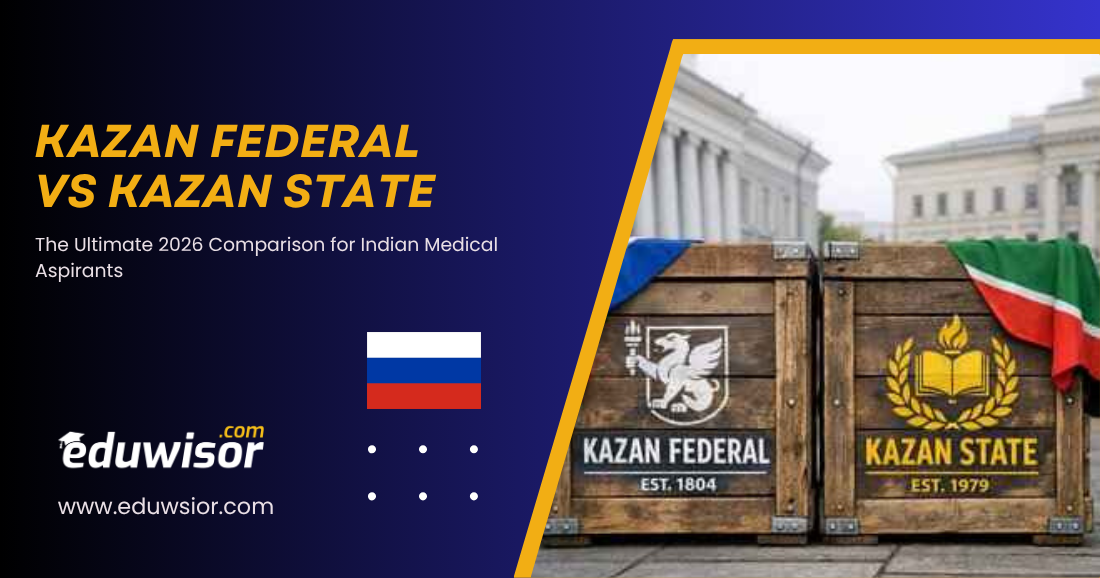
3. Kazan Federal University (KFU):
- One of Russia’s oldest and most prestigious federal universities.
- Location: Kazan (a vibrant, student-friendly city)
- Highlights: Strong Indian student community, excellent faculty, good FMGE support. Excellent balance of quality and cost.
- Approx. Annual Fee: ₹4.5 – ₹5.5 Lakhs
4. Crimean Federal University (CFU):
- Located in the picturesque region of Crimea.
- Highlights: Modern campus, affordable fees, moderate climate compared to mainland Russia. Gaining popularity rapidly.
- Approx. Annual Fee: ₹3.5 – ₹4.5 Lakhs
5. Novosibirsk State University (NSU):
- Part of the famous Akademgorodok (Academic Town), a hub of science and research.
- Location: Novosibirsk (Siberia)
- Highlights: Research-oriented education, strong fundamental science training. For students who love a quiet, academic atmosphere.
- Approx. Annual Fee: ₹4 – ₹5 Lakhs
6. Bashkir State Medical University:
- A well-established university known for its disciplined academic environment.
- Location: Ufa
- Highlights: Good hostel facilities, structured curriculum, value for money.
- Approx. Annual Fee: ₹3.8 – ₹4.8 Lakhs
Choosing Tip: Don’t just go by name. Consider your budget, adaptability to cold weather, preference for a big city vs. a university town, and the specific strengths of each institution.
Chapter 6: Life of an Indian Medical Student in Russia: Beyond Academics
What is it really like to live and study there for 6 years?
Academic Life:
- The MBBS program is 6 years (including 1 year of internship/housemanship). The first 3 years are pre-clinical (Anatomy, Physiology, Biochemistry), and the last 3 are clinical (Medicine, Surgery, Pediatrics, etc.).
- Teaching is a mix of lectures, practical lab sessions, and seminars. Exams are held twice a year (Winter & Summer sessions).
- The Russian language is taught intensively in the first two years, culminating in an exam. This is critical for communicating with patients during clinical rounds.
Daily Life & Climate:
- Winters are long and cold (Oct-Apr), with temperatures in cities like Moscow dropping to -15°C to -20°C. Cities are well-equipped with central heating everywhere indoors. Summers (June-Aug) are pleasant and mild.
- Indian student communities are strong. Most universities have Indian Student Associations that celebrate festivals like Diwali and Holi, providing a home away from home.
- Finding Indian groceries (pulses, spices) is easy in major cities. Hostel kitchens allow students to cook their own meals.
Challenges & Adaptation:
- Language Barrier (Outside University): While studies are in English, daily life requires basic Russian. Embracing the language is part of the adventure.
- Climate: The long winter and short daylight hours in peak winter can be challenging initially but are manageable with proper clothing and a positive mindset.
- Cultural Differences: Russian culture is different—more formal and direct. Understanding and respecting local customs is important.
Chapter 7: The Road After MBBS in Russia: Career Pathways & FMGE/NExT
Your degree is a passport to global opportunities. Here are the primary paths:
1. Practicing in India (The Most Common Path):
- Step: Clear the FMGE (Foreign Medical Graduates Examination), conducted twice a year by the NBE. It’s a tough exam with a historically low pass rate (~15-20%).
- Preparation: Start early (4th/5th year). Many students use online coaching platforms (e.g., Marrow, PrepLadder, DBMCI) alongside their Russian studies. Some universities also offer integrated FMGE coaching.
- After FMGE: A one-year compulsory rotating internship in India, after which you get permanent registration and can practice, pursue PG (NEET-PG), or join government service.
2. Pursuing Postgraduation (PG) Abroad:
- USA (USMLE Pathway): A popular and rewarding but long and expensive path. Take USMLE Steps 1 & 2 during your MBBS, do clinical clerkships, apply for residency (Match).
- UK (PLAB/MRCP Pathway): Clear the PLAB exams to get GMC registration and then apply for foundation training.
- Germany: Learn German to C1 level, clear the Fachsprachprüfung (language and medical exam) and Kenntnisprüfung (knowledge exam) to get a license.
- Other Countries: Australia, Canada, New Zealand, and Gulf countries also have specific licensing procedures.
3. Practicing in Russia or CIS Countries:
- Requires full fluency in Russian and clearing the Russian medical licensing exam. It can lead to a stable career, especially in fields like general medicine or research.
4. Higher Studies & Research:
- Pursue an MD/MS (a research-oriented degree) in Russia or a Ph.D. in biomedical sciences in Europe or the USA.
The New NExT Factor:
India is transitioning to a National Exit Test (NExT) which will replace both FMGE and NEET-PG. It will be a common exam for both Indian and foreign graduates. Stay updated on NMC notifications regarding its implementation.
Chapter 8: FAQs: Answering Your Pressing Questions
Q1. Is the MBBS degree from Russia valid in India?
A: Yes, if it is from an NMC-approved university. You must then clear the FMGE/NExT to practice.
Q2. What is the minimum percentage required in Class 12?
A: For General category: 50% in Physics, Chemistry, and Biology aggregate. For SC/ST/OBC: 40%. Some top universities may demand higher scores (up to 60-70%).
Q3. Are there any entrance exams for Russian universities?
A: Generally, no. Some universities like RUDN or Sechenov might have online interviews or subject-specific tests, but they are not as competitive as NEET.
Q4. How is the safety for Indian students, especially girls?
A: Russian university campuses and hostels are generally very safe with 24/7 security. Basic street-smartness and adhering to university guidelines are advised, as in any foreign country.
Q5. Can I work part-time during my MBBS in Russia?
A: Legally, your student visa allows part-time work with official permission from the university. However, the demanding MBBS curriculum makes it very difficult to manage a job. It’s not recommended as a means to fund your education.
Q6. What about food? Do we get Indian food?
A: Hostels have shared kitchens where you can cook. Indian groceries are available. Many cities also have Indian restaurants, but they are expensive for daily dining.
Conclusion: Is MBBS in Russia Without NEET the Right Choice for You?
The path of MBBS in Russia without NEET and with low fees is not a shortcut; it is a strategic alternative. It is ideal for students who:
- Have a genuine passion for medicine but found the NEET competition overwhelming for a seat in India.
- Come from middle-class families for whom private Indian medical college fees are prohibitive.
- Are self-motivated, adaptable, and possess a spirit of adventure to thrive in a new culture.
- Are disciplined enough to prepare for the FMGE/NExT concurrently with their foreign studies.
It demands resilience—to adapt to a new climate, culture, and language, and to maintain focus on the ultimate goal of clearing the licensing exam back home.
If you approach it with clear eyes, realistic expectations, and a solid plan for the post-graduation phase, a Russian MBBS degree can be the launchpad for a successful and respected global medical career. It opens doors not just to India, but to the world.
Final Advice: Do thorough research. Only deal with authorized representatives of universities. Talk to alumni. Verify every claim. Your medical career is a lifelong journey—ensure it begins on a foundation of verified information and thoughtful planning.
Eduwisor always guides students toward the right path with an unbiased approach. You can follow us on Youtube, Facebook, Instagram, Twitter, and Linkedin. Stay tuned for regular updates.
Interested in applying? Contact authorized Eduwisor consultant for a smooth admission process!
Act NOW—limited seats for 2026 intake! Call/WhatsApp: 9326395883/ 9076036383