
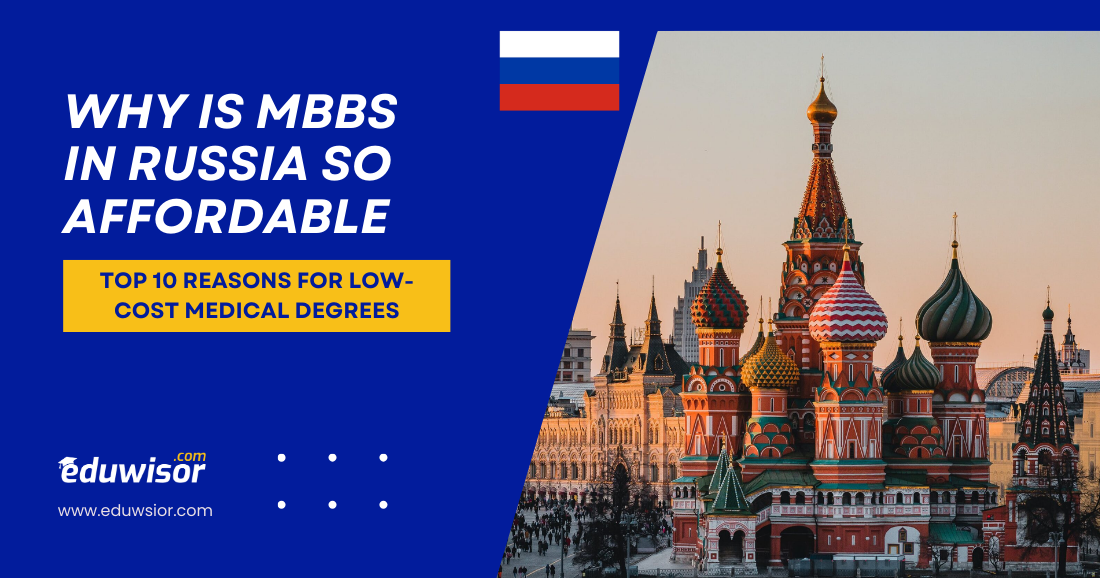
Every year, hundreds of thousands of aspiring doctors worldwide face a daunting reality: the exorbitant cost of medical education. In countries like India, the United States, the UK, or Australia, becoming a doctor often requires a financial investment that borders on the prohibitive, with capitation fees, donations, and high tuition creating insurmountable barriers. In this landscape of steep dreams, one destination consistently emerges as a beacon of affordability and quality: Russia. The question on every aspiring medic and concerned parent’s mind is: Why is MBBS in Russia so cheap? How can a country known for its robust educational infrastructure, advanced research, and European standards offer a world-class medical degree at a fraction of the cost seen elsewhere? Is there a catch?
This comprehensive 5500-word guide is your definitive resource. We will dissect the economic, political, educational, and strategic reasons behind the affordability of a Russian MBBS degree. We’ll move beyond the superficial “low fees” claim and explore the intricate ecosystem that makes this possible, while also providing a balanced view of the challenges and long-term value. Whether you are a student from India, Nigeria, the Middle East, or Southeast Asia, understanding the “why” behind the cost is the first step in making an informed decision about your medical future.
Chapter 1: The Core Philosophy – Education as a State Priority, Not a Commodity
To understand the affordability, one must first understand the post-Soviet educational philosophy. In Russia, higher education, particularly in critical fields like medicine, engineering, and sciences, is viewed as a strategic national investment, not merely a revenue-generating industry.
1. Historical Legacy of Subsidized Education: The Soviet Union established a vast network of high-quality universities accessible to citizens at minimal to no cost. While Russia transitioned to a market economy, the government retained a fundamental commitment to keeping core higher education, especially in state universities, heavily subsidized. This legacy means that the infrastructure, faculty payrolls, and research facilities are largely state-funded, reducing the direct financial burden transferred to students.
2. Government Funding & Control: A significant portion of the operational budget for top Russian state medical universities like Moscow State Medical University (Sechenov), Russian National Research Medical University (Pirogov), and Novosibirsk State University comes directly from the federal budget. The government sets tuition fees for international students at levels designed to be competitive and accessible, aiming to foster global goodwill and build long-term international relationships rather than maximize short-term profit.
3. The “Soft Power” Strategy: Affordable education for international students is a key element of Russia’s foreign policy and “soft power.” By attracting tens of thousands of students from Asia, Africa, and the Middle East, Russia builds a vast network of alumni who often become professionals, and sometimes leaders, in their home countries with a lifelong connection to Russia. This diplomatic and strategic value outweighs the potential income from higher tuition fees.
Chapter 2: The Economic Drivers – Cost of Living and Currency Dynamics
The “cheap” tag isn’t just about tuition; it’s about the complete financial package. Several macroeconomic factors play a crucial role.
4. Favorable Currency Exchange Rates: For students paying in USD, EUR, or INR, the Russian Ruble (RUB) offers a consistent exchange advantage. Even with fluctuations, the Ruble’s value against major currencies means that when you convert your dollars or rupees, you get more Rubles for your money. This directly translates to lower effective costs for tuition (quoted in Rubles) and all local expenses. An annual tuition fee of 400,000 RUB is significantly cheaper in USD terms today than it might have been a decade ago.
5. Lower Cost of Living Compared to Western Hubs: While cities like Moscow and St. Petersburg are more expensive, they are still considerably cheaper than London, New York, Sydney, or even major Indian private college cities like Manipal when considering hostel and living costs. In many university towns like Kazan, Krasnodar, Orenburg, or Tver, the cost of living is remarkably low. University-provided hostel accommodation can range from $500 to $1500 per year, not per month. Monthly food, transport, and utility expenses can be comfortably managed on $200-$400 outside the major capitals.
6. Absence of a Profiteering “Education Industry” Complex: Unlike countries where private medical colleges operate on pure market principles, driving prices sky-high through demand-supply gaps, Russian medical education is still dominated by respected state institutions. There is no culture of “capitation fees” or “donations,” which in countries like India can add $500,000 to $1 million to the actual cost. The fee you see on the university website is the fee you pay, with full transparency.
Chapter 3: The Structural Advantages of the MBBS in Russia System
The way Russian medical education is structured inherently reduces costs without compromising on core quality.
7. Efficient, Large-Scale Operations: Russian medical universities are massive institutions, often hosting 10,000-15,000 students across various faculties. This scale allows for efficient resource utilization—shared laboratories, centralized libraries, large lecture halls—which drives down the per-student operational cost. The model is built on volume with state support, enabling low individual fees.
8. Focus on Core Education Over Luxuries: While facilities are good and constantly upgraded, Russian universities prioritize functional, robust infrastructure over extravagant campus luxuries. The investment goes into anatomical museums, modern labs, and hospital affiliations rather than Olympic-sized pools or five-star student resorts. This focus on the academic essentials keeps overheads manageable.
9. Six-Year Direct MBBS Program: In many countries, becoming a doctor requires a pre-med bachelor’s degree (4 years) followed by an MD program (4 years), totaling 8 years of tuition fees. Russia follows a 6-year integrated “Specialist” program (equivalent to MBBS) straight after high school. This saves students two full years of undergraduate tuition and living costs, making the entire journey to a medical degree shorter and cheaper.
10. Subsidized Student Amenities: From incredibly cheap public transport passes for students to subsidized meals in university cafeterias and low-cost access to cultural institutions (museums, theaters), the Russian state extends its support to the student lifestyle, further reducing the overall financial burden.
Chapter 4: The Value Proposition: Is “Cheap” Synonymous with “Good”?
This is the most critical question. An affordable degree is meaningless if it lacks recognition or quality. Here’s how MBBS in Russia balances cost and value.
11. Global Recognition and WHO Listing: All major Russian medical universities are listed in the World Directory of Medical Schools (WDOMS) maintained by the World Health Organization (WHO). This is the foundational recognition that makes graduates eligible to sit for major international screening tests.
12. NMC (National Medical Commission of India) Approval: A select group of Russian universities (around 50+) are approved by India’s NMC. This is crucial for Indian students who wish to return and practice in India. Graduates from these approved colleges can sit for the FMGE/NExT exam. It’s vital to choose only an NMC-approved university.
13. High-Quality, Experienced Faculty: Russian medical schools boast professors and doctors with extensive experience, many holding advanced scientific degrees. The teacher-student ratio in practical and clinical classes is often favorable, ensuring hands-on learning.
14. Emphasis on Practical and Theoretical Foundations: The Russian curriculum is known for being rigorous, with a strong emphasis on fundamental sciences (anatomy, physiology, biochemistry) in the initial years and extensive hospital-based clinical rotations in the later years. Students get exposure to a high volume of diverse clinical cases.
15. European Standard Degree: The MD Physician (equivalent to MBBS) is a European-standard qualification. While practicing directly in the EU or US requires additional licensing exams (like USMLE or PLAB, which is true for almost any foreign graduate), the degree itself provides a solid foundation to pursue those pathways.
Chapter 5: A Detailed Cost Breakdown – Where Exactly Do You Save?
Let’s put numbers to the narrative. The following is an approximate annual cost breakdown for an Indian student at a mid-tier Russian state medical university (outside Moscow/St. Pete) for the 2026-27 session.
- Tuition Fee: $4000 – $6000 (₹3.3 Lakhs – ₹5 Lakhs)
- University Hostel Accommodation: $500 – $1200 (₹40,000 – ₹1 Lakh)
- Food & Groceries: $1500 – $2000 (₹1.2 Lakhs – ₹1.7 Lakhs)
- Medical Insurance (Mandatory): $150 – $300 (₹12,000 – ₹25,000)
- Miscellaneous (Local Travel, Books, etc.): $1000 – $1500 (₹80,000 – ₹1.2 Lakhs)
Total Estimated Annual Cost: $7,150 – $11,000 (₹5.9 Lakhs – ₹9 Lakhs)
Compare this to alternatives:
- Indian Private Medical College: Donation ₹50 Lakhs – ₹1 Crore + Annual Tuition ₹15-25 Lakhs.
- MBBS in USA/UK/Canada/Australia: Annual cost starts at ₹40-60 Lakhs per year.
- MBBS in Philippines/Georgia: Annual cost ₹6-9 Lakhs (comparable, but Russia often has an edge in infrastructure and European recognition).
The savings, especially when compared to Indian private colleges, are astronomical.
Chapter 6: Addressing the Challenges and Hidden Considerations
A balanced view is essential. The low cost comes with its own set of challenges that students must be prepared for.
16. The Language Barrier & Adaptation: While the MBBS program is in English, daily life and patient interaction during clinical rotations require Russian language skills. Universities provide intensive Russian language training throughout the course, but mastering it requires significant student effort. Adapting to the harsh climate, especially in winter, and a different food culture are also part of the journey.
17. The FMGE/NExT Hurdle for Indian Students: The passing rate for the Indian licensing exam (FMGE) for foreign graduates has historically been low (~20-30%). This is not a reflection of Russian education alone but a challenge for all foreign medical graduates. Success requires disciplined self-study parallel to the Russian curriculum, focusing on the Indian medical syllabus and pattern. This is the most critical “post-cost” factor for Indian students.
18. Distance from Home: Russia is far from South Asia or Africa. Travel costs can be significant, and students may feel homesick. The time zone difference can also make communication tricky.
19. Cultural and Social Adjustment: Building a social life initially can be challenging. However, most universities have large, active communities of international students, creating a supportive mini-society.
Chapter 7: The Strategic Decision – Is MBBS in Russia the Right Choice for YOU?
“Cheap” should not be the only criterion. Here’s a quick checklist:
Choose MBBS in Russia if:
- Your primary constraint is budget but you aspire for a globally recognized degree.
- You are a disciplined student capable of independent study to clear licensing exams like FMGE/USMLE.
- You are adaptable to new cultures, climates, and languages.
- You aim for a career in global health, research, or plan to pursue PG in other countries.
Reconsider or Explore Other Options if:
- Your sole goal is to practice in India and you are not confident in your ability to self-prepare rigorously for the FMGE/NExT alongside your studies.
- You or your family are uncomfortable with the idea of significant geographical and cultural distance.
- You require a luxurious, cushioned campus life over a functional, academic-focused one.
Conclusion: MBBS in Russia Affordability Meets Opportunity
So, why is MBBS cheap in Russia? It is the result of a unique confluence: a state-prioritized education model, strategic foreign policy, favorable economic factors, and an efficient, large-scale system that has preserved quality while rejecting commercialization.
The Russian MBBS pathway is a testament to the fact that financial accessibility and educational excellence are not mutually exclusive. It offers a viable, respectable door to the medical profession for thousands who would otherwise be shut out by the exorbitant gates of private medical education elsewhere.
However, it is a path that demands resilience, adaptability, and proactive planning. The low cost is the beginning of the story, not the end. The ultimate return on this affordable investment is a medical degree that, in the hands of a dedicated and strategic student, can open doors to a fulfilling career anywhere in the world. It is a practical, powerful choice for the resilient dreamer—the doctor who values substance over show, and opportunity over opulence.
Eduwisor always guides students toward the right path with an unbiased approach. You can follow us on Youtube, Facebook, Instagram, Twitter, and Linkedin. Stay tuned for regular updates.
Interested in applying? Contact authorized Eduwisor consultant for a smooth admission process!
Act NOW—limited seats for 2026 intake! Call/WhatsApp: 9326395883/ 9076036383